

Use Case
Cool Room Master · Container House Guide · Australia
How to Prepare Footings for a Container House (Hard-Stand Ground Guide)
Installing a container house starts with the base. The good news: you don’t always need a full concrete slab. In many cases a properly prepared level, compacted hard-stand ground with support pads is enough for a stable install — especially for site offices, storage, and container house shells.
Best for: site office · storage · shells
Focus: hard-stand + pads/piers
Includes: drainage · levelling · checklist
Focus: hard-stand + pads/piers
Includes: drainage · levelling · checklist
Quick Answer
If your site is hard, level, compacted, and well-drained, hard-stand ground is often suitable. The most common setup is a compacted base with level support pads at key load points.
Before Delivery
- Clear, level, and compact the footprint
- Confirm drainage (no pooling)
- Set support pads ready for levelling
- Ensure access for truck / crane
Do Container Houses Need Concrete Footings?
Not always. A container house does not automatically require a full concrete slab. For many common uses — like a site office, portable workspace, storage, or an empty shell — a correctly prepared hard-stand base is often sufficient.
Important (Australia): Council and engineering requirements vary by state and council area, especially for permanent living or habitable use. If you plan to use the unit as a dwelling, check local requirements before installation.
What Is Hard-Stand Ground?
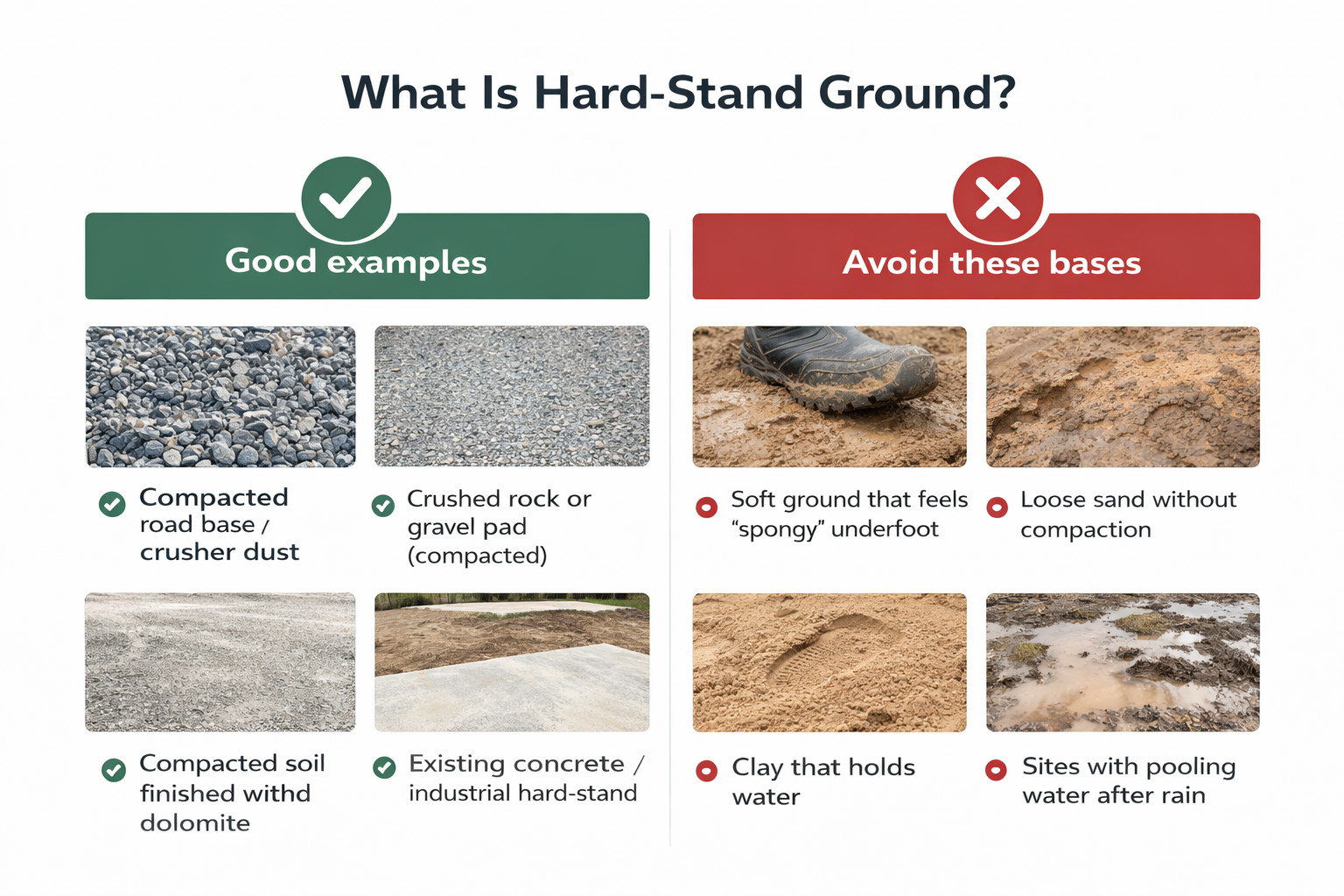
Hard-stand ground is a firm, load-bearing surface that is level, compacted, stable under weight, and well-drained.
Good examples
- Compacted road base / crusher dust
- Crushed rock or gravel pad (compacted)
- Compacted soil finished with dolomite
- Existing concrete / industrial hard-stand
Avoid these bases
- Soft ground that feels “spongy” underfoot
- Loose sand without compaction
- Clay that holds water with no drainage plan
- Sites with pooling water after rain
When Is Hard-Stand Ground Suitable?
Hard-stand ground is generally suitable if all of the following are true:
- The site is level (within installation tolerance)
- The base is mechanically compacted (not just “looks hard”)
- There is good drainage and no water pooling
- The ground is stable with no soft spots
- The unit is used as a shell or non-habitable structure (or where approvals allow)
Practical tip: Even on hard-stand, using support pads at structural load points improves stability and makes levelling easier.
Recommended Footing Options & Step-by-Step
1) Compacted Hard-Stand + Support Pads (most common)
The most popular approach. Prepare a compacted base and set level pads at load points — cost-effective and fast.
2) Concrete Piers (long-term stability)
Individual footings/piers at load points for firmer, longer-term support on trickier ground.
3) Existing Concrete / Industrial Hard-Stand
If you already have a sound slab or industrial hard-stand, it’s often ready to use with minimal prep.
- Clear & level the footprintRemove vegetation and topsoil; level the area to installation tolerance.
- Compact the baseMechanically compact road base / crusher dust for an even, load-bearing surface.
- Set support pads at load pointsPlace concrete pads/blocks/pavers at corners and any intermediate structural points.
- Final checks before deliveryConfirm drainage, pad heights, and clear access for truck / crane / forklift.
Access matters: A perfect base won’t help if the truck or crane can’t reach the site. Check driveway width, turning space, overhead lines, and soft ground along the delivery path.
Drainage Tips (Prevent Rust & Settling)
Water pooling is one of the biggest causes of long-term issues. Keep the base elevated and dry.
- Grade surrounding ground so water flows away from the unit
- Build the pad slightly higher than the surrounding surface
- Use crushed rock / road base for drainage and stability
- Keep any gutters/downpipes discharging away from the base
Common Mistakes to Avoid
Don’t do this
- Install on uneven ground and “hope it settles”
- Skip compaction because the soil “seems hard”
- Ignore drainage and leave the site flat
- Use loose blocks without levelling
Do this instead
- Level + compact properly (mechanical compaction)
- Use pads at structural load points
- Create drainage fall away from the footprint
- Re-check levels before delivery day
What We Supply vs What You Prepare
Footing and ground preparation is typically handled on-site by the customer or their contractor.
Base note: We supply the container house unit. The customer ensures the site has level, hard-stand ground ready for installation and suitable access for delivery. If unsure, speak with a licensed builder, concreter, or engineer — especially for permanent or council-approved use.
FAQ
Do I need a full concrete slab for a container house?
Not always. Many installations work well on a properly prepared hard-stand base with support pads. For permanent living or habitable use, council/engineering requirements may apply.
What is the best base for quick installation?
A compacted road base / crusher dust pad with level concrete pads at structural points is a common, cost-effective solution.
How do I stop water pooling under the container house?
Grade the area so water runs away, raise the pad slightly above surrounding ground, and use a compacted drainage layer like crushed rock or road base.
Where should support pads go?
At minimum, support the main structural load points (commonly corners). For longer or heavier units, add intermediate pads along structural lines to keep the frame level.
Ready to Install a Container House?
View the product specs and enquire today — we can help confirm whether a hard-stand base suits your site.
