

Use Case
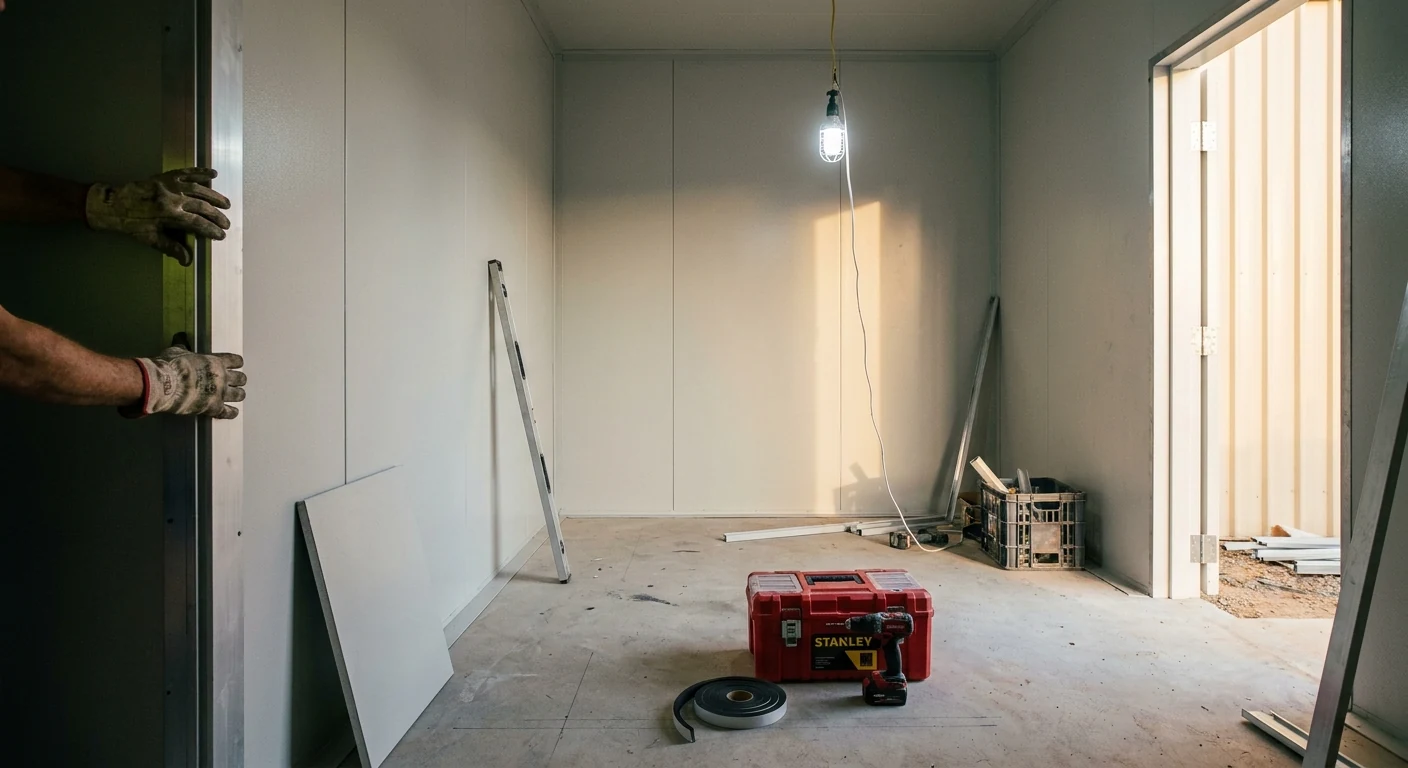
Fridge panelling — the insulated wall, ceiling and floor cladding used to build a walk-in fridge or cool room — is a specialist product, not generic foam board. Get the spec wrong and your unit either freezes solid, bleeds energy 24/7 or fails a council fit-out. This guide breaks down what to look for, the real prices in Adelaide for 2026, and how to choose between EPS, PIR and Rockwool cores without overpaying.
TL;DR: For most Adelaide cool rooms, 50mm EPS Z-lock panels at ~$41.74/m² are the right answer. Step up to 75mm or PIR for freezers and high-cycle commercial units. Rockwool only when fire-rating or acoustic comfort matters. Cool Room Master holds Adelaide warehouse stock — request a quote.
What Is Fridge Panelling?
“Fridge panelling” — also searched as cool room panelling, coolroom wall panels, or insulated cool room panels — refers to the sandwich-construction panels used to build the walls and ceiling of a walk-in fridge or cool room. Each panel is two thin Colorbond steel skins bonded to a solid insulating core, with an integrated tongue-and-groove (Z-lock) joining system at the long edges.
The panels stand vertical, lock together at the seams, and form a sealed insulated envelope. Standard panel cover widths are 950mm (35mm thickness) and 1150mm (50mm and 75mm thickness), with available lengths from 2.4m up to 6.0m for wall panels.
Where Fridge Panelling Is Used
- Commercial walk-in fridges — supermarkets, restaurants, butchers, fishmongers, cafés
- Walk-in freezers — bakeries, ice cream makers, frozen food processors, hospitality cold storage
- Hospitality cool rooms — pub bottle rooms, kitchen prep rooms, beverage storage
- Industrial cold storage — meat processing, dairy, produce packing, pharmaceutical
- Residential cool rooms — wine cellars, hunters’ game rooms, hobby cellars
- Mobile and trailer-mounted fridges — food trucks, mobile catering, event hire
- Cool room conversions of existing spaces — garages, sheds, granny flat extensions

The Three Core Materials — EPS, PIR, Rockwool
Every fridge panel sold in Australia uses one of three insulating cores. The skins (Colorbond steel) and the Z-lock joinery are essentially identical across all three. What changes is the foam in the middle, and that determines thermal performance, weight, fire behaviour and price.
EPS (Expanded Polystyrene) — The Default
White, closed-cell polystyrene foam. Light (~16 kg/m³ core), cheap, and easy to cut on site with a fine-tooth circular saw. R 1.3–1.5 at 50mm. Combustible — use within standard building applications.
Best for: Cool rooms at +2°C to +5°C, residential applications, budget commercial builds. Around 80% of Adelaide cool rooms.
PIR (Polyisocyanurate) — The Premium Option
Yellow rigid foam. Heavier than EPS (~40 kg/m³ core), more expensive, but the R-value per millimetre is unmatched. R 2.2–2.5 at 50mm — nearly double the insulating performance of EPS at the same thickness. Self-extinguishing fire behaviour.
Best for: Freezers (–18°C), 24/7 commercial cool rooms, applications where energy savings over years pays back the upfront premium.
Rockwool (Mineral Fibre) — The Compliant Choice
Dense mineral wool core (~80 kg/m³). The heaviest of the three and ~$$ to install. R-values sit between EPS and PIR (R 1.4–1.6 at 50mm). The standout is non-combustible fire behaviour and excellent acoustic dampening.
Best for: Container houses, site offices, granny flats, recording studios — anywhere fire compliance or noise control matters more than maximum R-value.
Fridge Panel R-Values at a Glance
R-value (thermal resistance) is the number that decides how hard your fridge unit has to work to hold temperature. Higher R = less energy = lower running cost over the life of the cool room.
| Panel Thickness | EPS | PIR | Rockwool |
|---|---|---|---|
| 50mm | R 1.3 – 1.5 | R 2.2 – 2.5 | R 1.4 – 1.6 |
| 75mm | R 2.0 – 2.2 | R 3.3 – 3.7 | R 2.1 – 2.3 |
| 100mm (on request) | R 2.7 – 3.0 | R 4.4 – 5.0 | R 2.8 – 3.1 |
R-values are indicative. Actual R-value depends on core density and panel construction. Our EPS Z-lock panels run a 16 kg/m³ core with 0.45mm steel skins (50mm R 1.3–1.5, λ 0.042 W/mK). For a project-specific R-value certificate, contact our team before ordering.
Adelaide Fridge Panelling — 2026 Pricing
Below are our published Z-lock wall panel prices (GST included). For the full per-metre and accessory breakdown see our complete 2026 pricing guide.
| Thickness | Per linear metre | Per square metre | Typical use |
|---|---|---|---|
| 35mm (950mm cover) | $33 | $35 | Partitions, dividers (not cool rooms) |
| 50mm (1150mm cover) | $48 | $41.74 | Standard cool rooms, +2°C to +5°C |
| 75mm (1150mm cover) | $63 | $54.78 | Freezers, 24/7 commercial |
How Much Does It Cost to Panel a Cool Room?
Quick worked example for a typical Adelaide cool room:
- 3m × 4m × 2.4m high cool room = ~33 m² of wall area + ~12 m² of ceiling area = 45 m² of panel
- At 50mm EPS @ $41.74/m² → ~$1,880 in wall and ceiling panels
- Add aluminium corner channels, top track, door hardware and a panel door → expect $3,000–$3,800 supplied ex-works Adelaide
That’s the panel-only build. Refrigeration unit, electrical, and any council compliance are separate line items.
Choosing Panel Thickness for Your Fridge
| Application | Recommended panel |
|---|---|
| Residential cool room (+5°C wine, hobby) | 50mm EPS |
| Hospitality kitchen cool room (+2°C to +5°C) | 50mm EPS |
| Commercial walk-in fridge (+2°C, daily use) | 50mm EPS or 75mm EPS |
| Walk-in freezer (–18°C) | 75mm PIR (preferred) or 75mm EPS |
| 24/7 supermarket-grade cold storage | 100mm PIR |
| Container house cool storage with fire compliance | 75mm Rockwool |
Rule of thumb: If you can’t decide between 50mm and 75mm, 50mm EPS is the right answer unless you’re running a freezer or the unit cycles 24/7. Don’t pay 30% more for thermal performance you won’t use.
Installing Fridge Panelling — The Basics

Fridge panels are designed for DIY-level installation provided you have basic tools and a plan. The flow:
- Floor preparation — flat, level concrete slab, or insulated subfloor for freezer applications
- Aluminium track — bottom and top tracks define the wall line
- Panel stand-up — vertical panels slot into the track and Z-lock together at each seam
- Corner channels — internal and external aluminium corners seal the wall returns
- Door installation — pre-cut panel door hung on stainless heavy-duty hinges with a magnetic gasket seal
- Sealing — silicone food-grade sealant at all internal seams; especially important around the door frame
A two-person team typically erects a 3m × 4m cool room shell in 1–2 days. See our parts and channels range for everything you’ll need beyond the panels.
The Adelaide Local Advantage
Most major Australian fridge panel suppliers ship from Melbourne or Sydney. That means interstate freight and 5–7 working days of waiting before you can start the build. For a typical cool room project, freight alone can cost $250–$450 — that’s roughly 5–10 square metres of panel.
Cool Room Master holds Adelaide warehouse stock in 35mm, 50mm and 75mm EPS Z-lock panels across the full length range. Adelaide metro gets same-week delivery; regional SA and Australia-wide are available on request. Our Adelaide stock page shows current availability.
Frequently Asked Questions
What’s the difference between fridge panelling and regular insulated wall panels?
Fridge panelling is a sub-category of insulated wall panels engineered specifically for cool room and freezer construction. The key differences are the Z-lock joinery for an airtight seal, food-safe Colorbond steel skin, and rigid core density rated for cycle-stable cold storage. Generic insulated panels (used for sheds, warehouses, factory cladding) don’t seal as tightly and aren’t engineered for the temperature differentials of a fridge.
What thickness fridge panel do I need?
50mm EPS is the default for cool rooms holding +2°C to +5°C. Step up to 75mm — or to PIR core — if you’re building a freezer or running the unit 24/7. 35mm is partition-grade only; don’t use it for a fridge.
Can I install fridge panelling myself?
Yes — most Adelaide customers install their own cool rooms. Tools needed: fine-tooth circular saw, drill, spirit level, silicone gun, ratchet straps for transporting panels. A 3m × 4m cool room shell typically takes a two-person team 1–2 days. Refrigeration plant installation should be done by a licensed refrigeration mechanic.
How much fridge panelling do I need for my cool room?
Multiply your perimeter by the wall height to get wall panel area. Add the ceiling square metres. Example: a 3m × 4m × 2.4m room needs (3+4+3+4) × 2.4 = 33.6 m² of wall panel plus 3 × 4 = 12 m² of ceiling panel = 45.6 m². Round up by 5–10% for cuts and waste.
How much does fridge panelling cost per square metre in Adelaide?
At Cool Room Master, 50mm EPS Z-lock fridge panels cost $41.74/m² and 75mm panels cost $54.78/m² (GST included, ex-works Adelaide warehouse). See our 2026 pricing guide for the full breakdown.
Do you stock PIR or Rockwool fridge panels?
EPS Z-lock is our standard stocked line in Adelaide. PIR and Rockwool panels are available on request for specific projects — typically freezers (PIR) or fire/acoustic-compliant builds (Rockwool). Contact us with your spec.
How long do fridge panels last?
Quality Z-lock EPS fridge panels with Colorbond skins routinely last 20+ years inside a cool room environment. The two failure modes to watch are gasket wear around the door (replace every 5–8 years) and silicone seal degradation at the joints (re-seal every 5 years).
Building a cool room? Get an Adelaide-stocked quote.
List your panel sizes, accessories and postcode — we’ll respond with a written quote, no quote-form games. Adelaide pickup, metro delivery or Australia-wide freight.
See also: our 2026 cool room panel pricing guide, Adelaide cool room panel stock page, EPS wall panel range, and channels, doors and hardware.
