

Use Case
Quick answer: For Adelaide food processing cold rooms, panel selection is governed by the operating temperature band — 50 mm EPS handles +1 °C to +8 °C produce/dairy, but anything below −10 °C requires 100–150 mm PIR with a properly detailed cam-lock joint. Wall and roof thickness should always be specified independently.
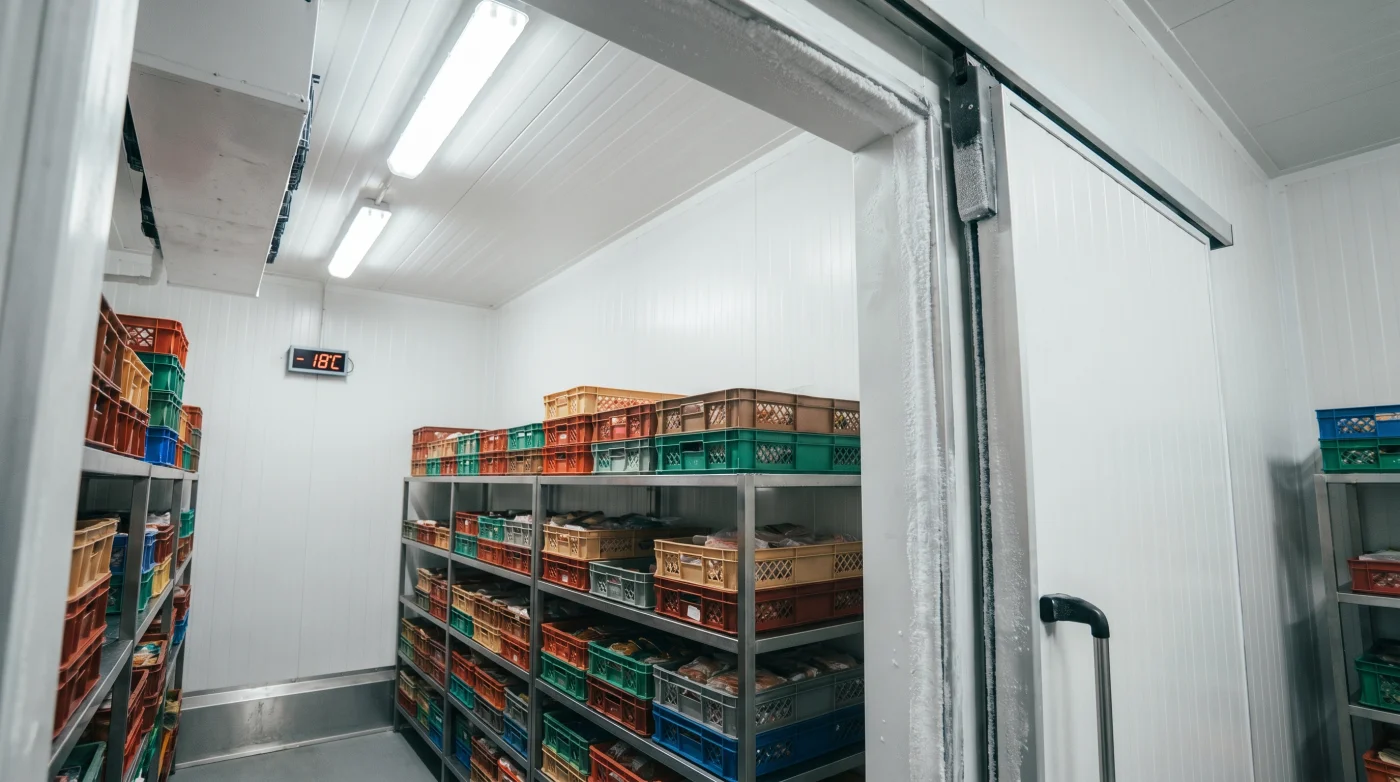
Why Food Processing Facilities Have Different Cold Room Panel Requirements
Walk into any commercial kitchen, bakery, or meat processing site in Adelaide and you’ll find the same conversation happening in private: the panels specified for the job aren’t the ones that arrived, or weren’t thick enough for the product temperature band, or the joint detail allowed condensation into the cavity.
Food processing facilities present a specific set of thermal and hygiene constraints that standard commercial refrigeration panels don’t always meet. The problem isn’t panel quality — it’s mismatch between the intended temperature band, the product load profile, and the panel specification written at procurement time.
This article covers the panel decisions that actually affect food safety compliance, energy consumption, and long-term structural performance for commercial food processing cold rooms in South Australia. Cool Room Masters supplies these panels from our Adelaide warehouse with delivery across Australia.
What this guide covers: temperature band → panel thickness mapping, EPS vs PIR decision criteria, joint detail failure modes, application-specific specs (bakery, dairy, meat, frozen), and a procurement checklist you can hand to a builder or supplier.
Temperature Bands and Panel Thickness: The Governing Constraint
Cold room panels are classified by their thermal performance — primarily the U-value (W/m²·K) or the R-value (m²·K/W). For a food processing facility, the relevant question is which panel thickness handles the required temperature band without condensation failure at the joint.
| Temperature Band | Typical Use | Min Panel Thickness | Panel Type | U-value (approx.) |
|---|---|---|---|---|
| +1 °C to +8 °C | Produce cold rooms, dairy processing | 50 mm | EPS or PIR | ≤ 0.44 W/m²·K |
| −10 °C to −25 °C | Freezer stores, seafood processing | 100–150 mm | PIR (mandatory) | ≤ 0.22 W/m²·K |
| −25 °C to −40 °C | Blast freezing, hypermarket distribution | 150–200 mm | PIR thick-core | ≤ 0.15 W/m²·K |
| Ambient to +5 °C | Controlled atmosphere storage | 75 mm | PIR | ≤ 0.30 W/m²·K |
The critical mistake at procurement is specifying a 50 mm panel for a −20 °C application because it’s what was stocked or quoted cheapest. At −20 °C, a 50 mm EPS panel will have an internal surface temperature above the dew point of ambient air on the warm side of the panel — the joint will sweat, drip, and eventually delaminate. For any application below −10 °C, PIR is not optional; it’s structural insurance.
✅ Adelaide stock — most common food processing specs
- 50 mm EPS Z-lock panels — produce, dairy, beverage cold rooms (+1 °C to +8 °C)
- 75 mm PIR panels — meat cutting, poultry chill (+0 °C to +12 °C)
- 100–150 mm PIR thick-core — freezer and seafood storage (−10 °C and below)
EPS vs PIR for Food Processing: The Practical Decision Framework
EPS (expanded polystyrene) and PIR (polyisocyanurate) are the two core panel cores used in commercial cold room construction across Adelaide. The choice between them isn’t binary — it’s application-specific. For a deeper side-by-side, see our EPS vs PIR Australian commercial guide.
When EPS is the right choice
- Cool rooms operating at +1 °C to +8 °C (beverage storage, produce, dairy)
- Projects with tight budget constraints where the temperature band genuinely supports EPS performance
- Internal partitioning between two refrigerated zones at similar temperatures
- Non-food processing applications (flower storage, pharmaceutical cold chain)
When PIR is the right choice — and often mandatory
- Any application at or below −10 °C (meat cutting rooms, frozen storage, blast chilling)
- Food processing facilities subject to FSANZ Food Safety Standards where condensation management is a documented prerequisite
- Facilities requiring a fire rating for insurer or council compliance
- Environments with high humidity or thermal cycling (loading docks, bulk cold storage)
Specifier note: For food processing facilities in South Australia, PIR panels with a fire rating of up to 2 hours (REI 120) are increasingly specified by commercial builders and required by councils in the Adelaide metropolitan area. Confirm the fire performance requirement with your building certifier before finalising panel type.
The Joint Detail: Where Food Processing Cold Rooms Fail
The highest-failure point in cold room installations for food processing isn’t the panel core — it’s the joint. Poorly detailed joints between panels cause:
- Thermal bridging and condensation at the panel-to-panel connection
- Air infiltration that increases compressor run time and energy cost
- Hygiene failures where moisture accumulates in the joint cavity and promotes mould or bacterial growth
- In extreme cases, structural delamination under thermal cycling
Cool Room Masters specifies tongue-and-groove joint details with pressure-equalising gaskets for food processing applications. The joint should be:
- Mechanically bridged (cam-lock or tongue-groove) — not just adhesive
- Gasket-sealed on both the internal and external face
- Visible for inspection post-installation (no hidden cavities)
Panel Thickness Selection for Common Food Processing Applications

| Application | Design Temp | Min Wall Thickness | Min Roof Thickness | Recommended Core |
|---|---|---|---|---|
| Bakery proof room | +18 °C to +24 °C | 50 mm | 50 mm | EPS |
| Meat cutting room | +10 °C to +12 °C | 75 mm | 75 mm | PIR |
| Dairy cold room | +2 °C to +4 °C | 50 mm | 75 mm | EPS or PIR |
| Frozen seafood storage | −20 °C to −25 °C | 125 mm | 150 mm | PIR |
| Poultry processing chill room | +0 °C to +2 °C | 75 mm | 100 mm | PIR |
Note: roof panels always run thicker than wall panels in the same application — the internal heat gain from lighting and thermal buoyancy loads the roof at a higher rate. Always specify roof and wall independently; don’t assume a single thickness covers both.
What to Include in Your Cold Room Panel Specification for Food Processing
Before approaching a supplier or builder, have these parameters defined:
- Design temperature — minimum and maximum operating temperature
- Product load profile — the thermal mass of product being introduced per hour
- Ambient design — Adelaide summer design dry bulb (+42 °C) and wet bulb (+25 °C)
- Panel core type — EPS, PIR, or composite
- Required thickness — independently specified for wall and roof
- Fire rating — required REI classification if applicable
- Joint detail — specify mechanical + gasket; no plain butt joints
- Hygiene lining — white steel liner vs stainless for meat/poultry processing
Related Cool Room Masters Resources
- EPS vs PIR Cold Room Panels: The Australian Commercial Project Guide — direct comparison with thermal performance data
- What Thickness Coolroom Panel Do You Need? (Australia) — sizing logic and temperature band guide
- Cool Room Cost Australia: Pricing, Sizes & Freezer Guide — cost framework for commercial budgets
- Bunnings vs Direct Supplier: Coolroom Panel Cost & Quality — procurement channel guide
- Best Coolroom Panels for Adelaide: Why EPS Wins — Adelaide climate-specific guidance
FAQ
What is the minimum panel thickness for a commercial food processing cold room in Adelaide?
For cool rooms operating at +1 °C to +8 °C, a minimum 50 mm EPS or PIR panel is typically acceptable. For temperatures below −10 °C, PIR panels of 100–150 mm are required to prevent condensation failure at joints. Always specify wall and roof independently.
Do food processing facilities require PIR panels instead of EPS?
PIR is recommended for any food processing facility operating below −10 °C or with high humidity/thermal cycling. For standard cool rooms (+1 °C to +8 °C) in bakery, produce, or dairy applications, EPS panels are sufficient if properly specified and joint details are correctly executed.
What Australian standards apply to cold room panels in food facilities?
Cold room panels used in food processing must comply with the Food Safety Standards (Australia New Zealand). Relevant standards include AS 4674 (Design, construction and fit-out of food premises) for the building side, and the panel system should carry a manufacturer fire test report to the relevant NCC fire resistance level for the occupancy class.
Can I use Bunnings cold room panels for a commercial food processing facility?
Bunnings stock panels are generally suitable for domestic or small-scale commercial applications with consistent temperature bands above +4 °C and low humidity. For food processing facilities with temperature-controlled environments, health department requirements, or fire rating requirements, specialist panel suppliers offer better specification control, joint detailing, and compliance documentation.
How do I prevent condensation at panel joints in an Adelaide food processing cold room?
Use mechanically bridged tongue-and-groove or cam-lock joints with pressure-equalising gaskets on both internal and external faces. Avoid plain butt joints sealed only with adhesive. Select panel thickness that keeps the warm-side surface temperature above the local dew point — Adelaide’s summer design wet bulb of +25 °C should drive the calculation, not the average annual humidity.
